
Tag Archives: highway code

You, Your Quingo and the Highway Code

It’s great to have the freedom and access a Quingo gives you over the winter months.

On the blog this week we wanted give you a refresher on the Highway Code for scooter users, so you can ride around this winter with maximum confidence!

The Highway Code offers essential guidance for your safety and the safety of others, and we will discuss the easy things to remember when out and about.

Using Pavements

A class 2 scooter that is restricted to 4mph, or a class 3 scooter that has been switched to the limited 4mph setting can both be used on pavements.

At all times, pedestrians have right of way on footpaths. You must always allow them to pass first, giving them ample space to move out of your way.

It goes without saying, but you must always exercise extra caution around both the elderly, who may have visual impairments or be hard of hearing, and young children who may not become aware of you as quickly.

Extra caution must also be taken when attempting to cross a road. The best thing to do is to find a drop down kerb, ideally at a pedestrian crossing. With standard scooters it is advised that you approach kerbs from straight on, however with a Quingo it is safe to approach at an angle of up to 45° – this is due to the stability of Quingo’s 5 wheel technology.

Mobility scooters must not use cycle lanes, bus lanes or motorways.
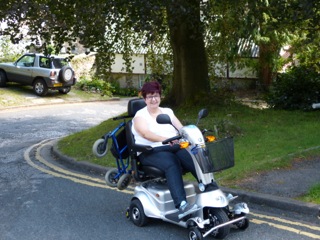
Quingo Scooter user

Using Roads

In order to use your scooter on the road, it must comply the specifications of a class 3 scooter. Class 3 scooters must not be used on the road.

Your scooter must be capable of more than 4mph and have an upper speed limit of 8mph. It must also feature a switch allowing the top speed to be limited to 4mph for use on footpaths and pavements.

The scooter must feature a headlight, rear lights, flashing indicators, a horn and a mirror.

It is important to consider that if you use your scooter on the road, you are more vulnerable as you are exposed and slower than other vehicles. But if you adhere to the Highway Code at all times – keeping to the left side of the carriageway, following all signs and signals and using your lights and indicators as appropriate – you should be good to go!

At junctions, remember to take extra care and ensure that there is no vehicle likely to cross your path. Remember to always look behind you before you pull out.

When turning right:

  1. Pull to the left hand kerb
  2. Make sure there is no oncoming traffic
  3. Look behind you, not just using your mirrors
  4. Ensure there are no vehicles coming from behind
  5. Execute your manoeuvre!

If there is a roundabout incorporated into your journey, try to find an alternative route. This is because they offer greater risks to the slower moving and less visible scooter. If this is not possible simply remember to exercise great caution.

Quingo Road 2
Quingo user driving on the road

Parking

The rules for parking your mobility scooter on public highways are similar to the rules parking a car. If you park your scooter on a footpath you must not obstruct the footpath and it must be clearly visible.

Being Seen

We strongly advise that you wear high visibility clothing in addition to having lights on your scooter, to ensure maximum visibility!

Some more advice for being seen on the roads can be found in our previous article on preparing for the darker evenings.

This information is for general guidance only – please check the UK Government website for more details.

About Quingo

The Quingo Scooter range features six models to suit your needs and budget. For more information on the Quingo Scooter range, please visit our website. Alternatively, if you have any questions you can always contact us or call customer services on 01582 430 900.

Keep up to date with the latest mobility scooter advice, tips and interesting places to visit on the Quingo Scooter Users Blog. Quingo are proud to work closely with Age UK and feature regularly in local press. Connect with Quingo and keep up to date with all our latest news on Facebook and Twitter.

All Quingo Personal Mobility Vehicles are provided by Forever Active, the UK’s exclusive distributor. Forever Active is a trading name of Advantage Marketing Corporation Limited (AMC).  AMC Limited is an appointed representative of First Senior Insurance Services Ltd which is authorised and regulated by the Financial Conduct Authority. First Senior Insurance Services FSA Register number is 308478.


Mobility Scooters and the Highway Code – Part 2

In the second part of a two-part series on the Highway Code and mobility scooters, Quingo take a closer look at what the Highway Code says about driving on the road.

In our last blogpost we talked about the difference between Class 2 and Class 3 vehicles as well as driving your Quingo on pavements.

Mobility scooters and the Highway Code: Driving on roads

When driving on the road the Highway Code states that Class 3 vehicles should drive in the direction of the traffic, whilst Class 2 users should always use the pavement in situations where it’s possible. If you’re travelling at night, lights must be used and you should travel in the direction of the traffic so as not to confuse other road users.

Quingo Scooters
Quingo user driving on the road

It’s important to remember that you must follow the same rules about using lights, horns and indicators that apply to cars and other vehicles on the road.

You should be aware that other road users may not be able to see you as scooters are less visible than cars. For instance, you should ensure that you’re as visible as possible. You could do this, for example, by wearing a reflective jacket when driving your Quingo.

Dealing with junctions safely

You should take greater care at road junctions. The Highway Code points out that when you’re driving straight ahead, you should check to see that there are no vehicles about to cross your path from either the left or right, or overtaking you and turning left at the approaching junction.

There are a number of ways you can deal with right turns, particularly when turning from a major road. If you encounter a situation where moving into the middle of the road can be potentially awkward or dangerous, you can stop on the left-hand side of the road and patiently wait for a safe gap in the traffic.

Alternatively, you could negotiate the turn as a pedestrian by, for example, travelling along the pavement and crossing the road between the pavements where it’s safe for you to do so.

If the junction you want to navigate is too hazardous, you might wish to consider using another route for your journey. It may be safer for you to use the pavement for example. However, if you’re driving a Class 3 vehicle on the pavement you must remember to reduce your speed to no more than 4mph.

Parking your Quingo

As far as parking your Quingo goes, the Highway Code states that “all normal parking restrictions should be observed.”

Your Quingo 5 wheel scooter shouldn’t be left unattended in a place where it can cause an obstruction to other pedestrians – especially those in wheelchairs.

It’s worth noting that under the Blue Badge scheme, all vehicles that display a valid Blue Badge can benefit from parking concessions.

Mobility Scooters and the Highway Code – Part 1

Our customers’ safety and welfare is our main priority. In the first blog post of two parts, the Quingo team want to look at the Highway Code and what it has to say surrounding mobility scooters.

What is the Highway Code?

The Highway Code is a compendium of advice, information, guides and mandatory rules for all road users in the UK. Its main purpose is to promote safety on the roads.

The Highway Code applies to pedestrians, animals, cyclists, motorcycles, drivers and mobility scooter users. It’s prepared and updated by the Department for Transport and the Driving Standards Agency.

First published in 1931 as an 18-page booklet, the Highway Code has been regularly updated ever since to reflect the changing nature of Britain’s roads.

The difference between Class 2 and Class 3 vehicles

The Highway Code places mobility scooters into two separate categories: Class 2 and Class 3. Class 2 vehicles can’t go any faster than 4mph and are designed to be used on pavements.

Examples of Class 2 vehicles include the Quingo Classic, the Quingo Flyte, the Quingo Compact and the Quingo Air. Class 2 users should always use the pavement where it’s available. Where there is no pavement, due caution should always be taken.

Class 3 vehicles include the Quingo Plus, the Quingo Vitess and the Quingo Toura. These scooters have a maximum speed of 8mph and are equipped to be used on the road as well as the pavement. This topic is also included in the FAQs section of this website.

Mobility scooters and the Highway Code: Driving on pavements

When driving your scooter, you should be aware that pavements are safer than roads and they should be used when available. The Highway Code also observes that you should give pedestrians priority and show consideration of other pavement users.

Quingo Scooters
A Quingo scooter user on the pavement

If your Quingo 5 wheel scooter can go faster than 4mph, it’s important to remember that you mustn’t go any faster than this speed in pedestrian areas or on pavements. You might have to reduce your speed to adjust to other pavement users who might not be able to get out of your way quickly enough, or in situations where the pavement’s too narrow.

Special care should be taken when moving off the pavement onto to road. You should always look around and make sure it’s safe to join the traffic. When driving back onto the pavement, you shouldn’t try and negotiate a kerb that’s higher than the specifications outlined in your Quingo’s individual handbook & service manual.

Safety and mobility

Your safety when driving your Quingo is our main priority. That’s why we recommend to all of our customers to regularly refer to the Highway Code – the number one resource for road safety.

Keep a lookout for our next blog post in which we’ll be talking about what you need to consider when driving your Quingo on the roads.